Redundancy Announcement and Communication Plan
In partnership with Clover HR
In partnership with Clover HR
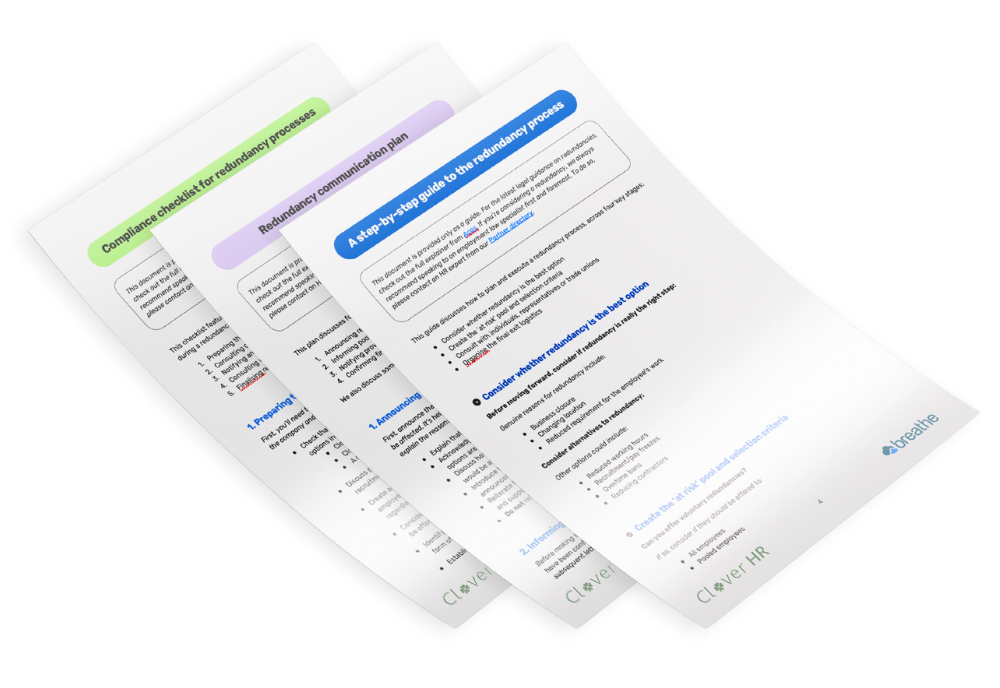
This resource was created in partnership with Lynn Burman, Commercial Director at Clover HR: an expert HR consultancy and trusted Breathe Partner. It’s intended as a general guide only. For the latest legal advice on redundancies, check out the full explainer from Acas. And if you’re considering a redundancy – or need HR advice of any kind – it’s always best to speak to an employment law specialist. You can get in touch with Clover HR here or find additional support through our Partner Directory.
This plan discusses four types of redundancy communications, including:
We also discuss some essential features of effective redundancy communication.
First, announce the redundancy process to the whole organisation, including those who won’t be affected. It’s helpful to do this at an all-company meeting, where the CEO or Founder can explain the reasons and take questions directly. Here’s what this discussion might include:
Explain that you are considering making redundancies and the reasons why.
Acknowledge how difficult this process will be for employees and discuss what support options are available.
Discuss how many redundancies are being considered and which areas of the business would be affected.
Introduce the consultation process, explaining timelines for future updates and announcements.
Reiterate the company policy on redundancies, including any relevant rights, benefits and support.
Do not refer to specific job roles or people who may be affected.
Setting the tone early and being transparent helps demonstrate a fair redundancy process and may protect the business if challenged later, such as through an employment tribunal.
Before selecting specific redundancies, make a ‘redundancy selection pool’ of candidates. When the selection pool has been confirmed, you should inform these employees in a meeting and confirm details in a subsequent letter.
Confirm the candidates are ‘at risk’ of redundancy.
Explain how the selection pools work and confirm the number of redundancies that will be made.
Discuss the reasons redundancy is being considered and why this pool has been selected.
Consider ways to avoid redundancy, e.g. pay cuts, hiring freezes and reducing contractors/third-party support.
Explore what voluntary redundancy options are available and if there are any alternative internal positions that could be available to pooled candidates.
Reiterate that no final decision has been made on specific individuals to be made redundant.
Talk through the rest of the redundancy process, how it will work and what timelines will be expected.
Introduce the selection criteria and explain how you will score employees. Remind employees of their right to have trade union or employee representative support at any relevant meetings.
Confirm all these details in writing with a first letter sent to each affected employee.
Clearly outlining the redundancy process in this way helps protect against claims of unfair dismissal.
Once scoring is complete, you will have a provisional list of candidates who will be made redundant. Now, explain the provisional selection to candidates in a further meeting and confirm details in writing.
Confirm the employee has been provisionally selected for redundancy.
Remind them that this decision isn’t final.
Summarise the process and consultation so far, including the selection criteria used to score employees.
Answer any questions the employee may have.
Discuss why the employee has been selected and run through their scores.
Include an invitation to an individual consultation meeting and remind employees of their right to bring trade union support or an employee representative to this meeting.
Confirm all these details in writing with a second letter sent to each affected employees
Once individual consultation is over, you’ll be in a position to confirm the redundancies. This decision is still subject to an appeal, but only if the employee chooses to do so.
Confirm the candidate has been selected for redundancy and reiterate the criteria used to make this decision.
Discuss the final day of employment.
Explain redundancy payment, plus any additional payments, such as those for outstanding holiday days, or payment in lieu of notice. Go through the final redundancy package and explain the employee’s specific entitlements.
Consider what support options will be available to the employee and what measures the company will take to help them find alternative employment.
Remind the employee of their right to appeal this decision through an appeals process.
Confirm all these details in writing with a third letter sent to each affected employee.
Restructures and redundancy can create conflict, disruption and feelings of resentment. Good communication can reduce this as much as possible. Here are five features of effective redundancy communication:
Empathetic: Be patient with employees and acknowledge that the process will be difficult. Try and avoid relying on corporate jargon where possible, as it can be frustrating and dehumanising for the employees reading it.
Proactive: Employees shouldn’t feel like they’re constantly chasing for answers and being left in the dark. You should therefore provide as much information as you can, as soon as you reasonably can.
Personalised: There are few things more frustrating during redundancy than receiving information that isn’t relevant to you. Try to avoid taking a one-size-fits-all approach, ensuring comms are specific to the person receiving them.
Face-to-face: It’s always better to receive bad news face-to-face rather than through an email or letter. Any new information should ideally be delivered via a virtual or in-person meeting, involving the employee’s direct line manager, as well as relevant HR stakeholders. Then, details can be confirmed in writing via email.
Consistent: Employees shouldn’t have to hear one thing in a meeting, another in a letter and another thing entirely through the employee grapevine. Make sure that everybody communicating a change or policy knows what to discuss and how they’re going to do it, so that nobody is getting contradictory information throughout the organisation. Worried about staying compliant in a redundancy situation?
Worried about staying compliant and running a fair redundancy process?
Whether you’re managing a workplace restructure, navigating a redundancy process or facing another HR challenge, Breathe helps you stay compliant, organised and in control. And if you need personal, expert advice, Clover HR (or one of our trusted partners) can guide you through it all.


.webp?width=564&height=513&name=Group%2029%20(1).webp)