.svg)


.svg)
No employer wants to make redundancies, and deciding who’ll be affected is the part that keeps leaders up at night. After all, every employee in your organisation is a human being who needs to be treated fairly and with respect.
That’s why it’s so important to follow a fair, well-structured redundancy selection process. In this guide, we break down how to select employees for redundancies using clear, objective redundancy selection criteria.
Skip to:
What is the redundancy selection process?
The redundancy selection process is the step where you decide which roles and which people may be made redundant.
It usually happens after you’ve confirmed the need for compulsory redundancies and explored alternatives such as voluntary redundancy or redeployment. This step sits alongside the redundancy consultation process, allowing employees to be part of the discussion before you finalise any scores or decisions.
A fair redundancy selection process has clear benefits for the business, helping you:
-
Protect key skills your business needs
-
Make decisions you can explain openly
-
Stay compliant with the Employment Rights Act 1996 and the Equality Act 2010
-
Treat people with dignity at a time when they need it most
A compliant redundancy selection process usually includes the following five steps.
Step 1. Decide which employees are at risk of redundancy
Begin by deciding which group of employees is at risk of redundancy. This group is called the redundancy pool. Often, it includes:
-
People doing the same or very similar work
-
People with interchangeable or overlapping skills
-
Anyone you could reasonably redeploy into the at-risk role
Example: If you no longer need three full-time sales staff and need to eliminate two roles, the obvious choice might be those three employees. But if other employees in the business have similar skills or already perform overlapping duties, you might also include them in the pool.
A fair redundancy pool protects you from unfair dismissal claims and helps you avoid indirect discrimination under the Equality Act 2010. Problems often arise when employers narrow the pool too tightly, excluding employees who should have been considered.
When you may not need an employee selection pool
You don’t always need to create a redundancy selection pool. It may be reasonable to skip this stage if:
-
A role is genuinely unique, and only one employee can do it
-
You’re closing an entire site or business, meaning all roles are affected
In these cases, you’d move straight into the next stages of the redundancy selection process.

Step 2. Choose objective selection criteria for redundancy
Once you’ve defined your selection pool, the next step is drawing up a list of redundancy criteria to help you decide who to make redundant. This is a set of rules or factors that companies use to decide who to make redundant. The criteria should be job-related and non-discriminatory to create a fair redundancy selection process.
Examples of fair redundancy selection criteria
Your redundancy selection criteria should focus on the requirements set out in employees’ contracts and their ability to do the job, rather than personal opinions or characteristics. Your criteria shouldn’t disadvantage employees because of who they are, for example, their age, gender, race, disability, or sexual orientation (known in law as protected characteristics), or because they’ve taken statutory leave.
Here are commonly used, lawful criteria you can share with your employees:
-
Skills, knowledge, experience, and qualifications relevant to the role
-
Performance scores or the ability to meet objectives, based on recent, reliable records
-
Disciplinary records (excluding informal disciplinary action)
-
Attendance records (excluding certain types of statutory leave)
-
Flexibility, or the ability to work across similar skills or functions
-
Any other fair job-related factors that matter to your business, for example, the need for employees with multiple skills in a reorganised team
How to avoid discrimination during redundancies
Some ways of choosing employees for redundancy might seem fair on the surface, but can end up unfairly affecting certain groups more than others. This is known as indirect discrimination, and the following criteria examples show what it can look like in practice.
-
“Last in, first out” which can disadvantage younger employees
-
Rating people based on “attitude” or “fit” which may be too subjective and open to bias
-
Treating part-time workers less favourably than their full-time colleagues, which can disadvantage those who might have caring responsibilities
Step 3. Build a redundancy scoring matrix
Once you’ve chosen your redundancy selection criteria, the next step is to create your redundancy scoring matrix. This simple tool scores employees consistently against each of the criteria points you’ve chosen, so your decisions are structured and backed by logic. A redundancy matrix:
-
Removes personal opinion from the decision=making process
-
Reduces the risk of unfair dismissal claims
-
Compares more than one employee fairly
-
Shows employees how you reached your decisions
How to score employees fairly
There’s no legally required scoring scale in UK employment law. Small to medium-sized businesses typically use a simple 1-3 or 1-4 scale because it keeps scoring straightforward. But some employers use 1-5 or even 1-10 for certain criteria they want to give more weight to. The key is to choose a scale that’s easy to apply consistently and fits the level of detail you need.
To protect the fairness of the redundancy selection process:
-
Make sure the same people score all employees considered for redundancy and apply your scoring matrix in the same way
-
Avoid personal opinions in your scoring; require evidence such as performance reviews, attendance records (excluding protected absences), or documented training records.
-
Base your decisions on a range of factors, not just one
After scoring, you might focus on choosing the employees with the lowest scores for redundancy. Then, share and discuss these scores during consultation before finalising your decisions.
Example redundancy scoring matrix
|
Selection criterion |
Score range |
What the scores mean |
|
Skills and qualifications |
1-5 |
1 = lacks required skills; 5 = fully competent with strong additional skills |
|
Performance |
1-5 |
1 = consistently below targets; 5 = consistently meets or exceeds objectives |
|
Disciplinary record |
1-3 |
1 = active warnings; 3 = clean record |
|
Attendance record |
1-5 |
Exclude disability-related or statutory leave (parental, adoption, paternity, shared parental, bereavement) |
|
Flexibility/multi-skilled ability |
1-5 |
1 = limited flexibility; 5 = can perform multiple similar roles |
Step 4. Check for discrimination risks before finalising your decisions
Before you confirm your redundancy scores, pause and check that your selection criteria and scoring decisions doesn’t disadvantage a particular employee or group.
This is a legal requirement under the Equality Act 2010, and a safeguard that helps you avoid discrimination (such as pregnancy or disability discrimination) and unfair dismissal claims at an employment tribunal.
Here’s how to monitor for discrimination effectively:
Look for patterns in your scoring
Check whether people with protected characteristics, such as disabled employees, pregnant employees, younger employees, or those on parental leave, are consistently scoring lower. If a pattern appears, revisit the criteria to check for unintentional bias.
Review your employee’s disciplinary record and attendance carefully
Some absences must be excluded from scoring entirely, such as disability-related absence, pregnancy-related leave, parental leave, parental bereavement leave, adoption leave, and paternity leave. If you’ve already removed these, double-check that no related patterns slipped through.
Check whether your redundancy criteria disadvantages a particular group
For example, any criteria around flexibility can indirectly discriminate against employees with caring responsibilities, and length of service can disadvantage younger employees.
Seek guidance if uncertain
If a score looks unfair or any of your criteria could indirectly discriminate against some employees, it’s worth pausing before finalising your decisions.
You may want to check your approach with an HR professional or an employee representative. (This is someone chosen by the workers in your organisation who are at risk of redundancy to raise questions on their behalf). A second perspective can highlight concerns that you may have missed.
Step 5. Document your decisions and communicate with your employees
The final step is to document how you reached your decisions and communicate them clearly. Good documentation protects your business, and clear communication supports your people through a difficult time.
Keep written evidence for every decision
Employment law doesn’t require an exact format, but you’ll need written evidence showing:
-
The fair selection criteria you used
-
How you applied those criteria and scored employees
-
Notes explaining why each score was awarded
-
Any adjustments you made to avoid redundancy discrimination
-
Copies of any correspondence you shared during the consultation process
The CIPD recommends storing redundancy records for at least six years, as they may be needed if a decision is challenged at an employment tribunal.
Communicate openly with affected employees
When you share outcomes with employees, explain:
-
The redundancy selection process you followed
-
How you applied your redundancy selection criteria
-
Their individual scores or selection outcome
-
Their right to ask questions, challenge factual inaccuracies, or appeal the decision if it feels automatically unfair
A recognised trade union representative or chosen employee representative can help employees understand the redundancy decision and take part in discussions on their behalf.
Here’s a redundancy communication plan you can borrow, taken from our Redundancy Toolkit.
Protect your business with secure document storage
Keeping accurate records and communicating clearly proves that you used a non-discriminatory redundancy process. This makes it easier to defend your decisions if you're challenged later.
Tip: Instead of storing this information in multiple locations or filing cabinets, it’s easier and more secure to store it in a single HR management system like Breathe. Whenever you need to access the details, you have fast, easy, and centralised access to employee records and audit trails.

Stay supported and compliant throughout the redundancy selection process
Choosing employees for redundancy will never feel easy, nor should it. These decisions affect peoples’ livelihoods and the success of your business going forward. Even so, a clear, well-structured redundancy selection process gives you something to lean on when the stakes are high.
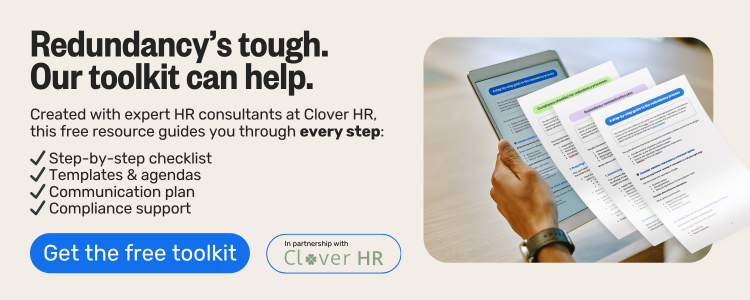
If you’d like a little extra guidance, Breathe’s Redundancy Toolkit includes letter templates, compliance checklists, and helpful examples to support you through each stage of the redundancy process. It’s a free online resource, created in partnership with employment law experts at HR consultancy, Clover HR.
Or, if you’re looking for formal HR or legal support to make sure your redundancy process is smooth and compliant, you can contact Clover HR or any of the qualified HR consultants in the Breathe Partner Programme directly.

 Business Process