'At risk' redundancy letter template
In partnership with Clover HR
In partnership with Clover HR
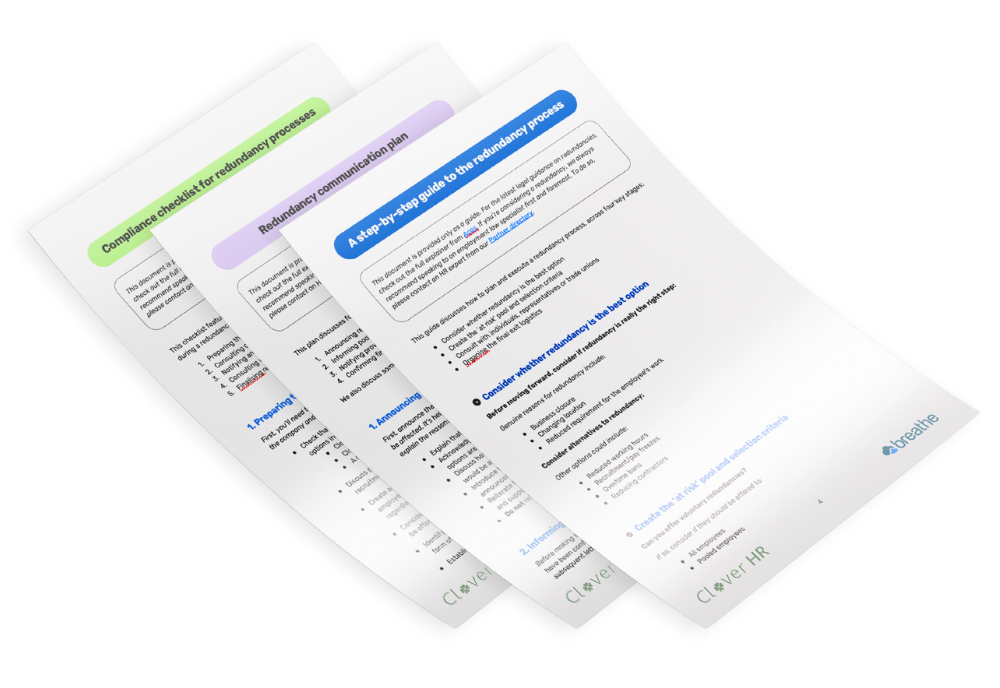
This resource was created in partnership with Lynn Burman, Commercial Director at Clover HR: an expert HR consultancy and trusted Breathe Partner. It’s intended as a general guide only. For the latest legal advice on redundancies, check out the full explainer from Acas. And if you’re considering a redundancy – or need HR advice of any kind – it’s always best to speak to an employment law specialist. You can get in touch with Clover HR here or find additional support through our Partner Directory.
Before deciding which candidates to make redundant, you need to identify an ‘at risk’ pool of candidates. This will usually include anybody on a particular team where redundancies will apply. When this pool has been chosen, you will need to inform candidates that they’re at risk, how this works and what the process will involve from here.
This template provides a basic outline of the information you’ll need to provide.
Directions for use:
[Blue] - Elements in blue square brackets should be customised as appropriate.
[Purple] - Elements in purple square brackets only apply if more than 20+ employees are being made redundant, since this threshold triggers collective consultation rules.
[Date]
Dear [employee],
As you will be aware, [name of organisation] is currently considering making redundancies, for the following reasons:
[Reason #1]
[Reason #2]
[Reason #3]
I am very sorry to inform you that your job role has been selected as a candidate for redundancy, meaning you are currently ‘at risk’. This is because we are considering making redundancies on your team.
[Explain how many redundancies/what proportion of roles will be affected].
This letter confirms that you are a candidate for redundancy. However, I would like to stress that no decisions have yet been made on specific employees that could or will be selected.
As such, a formal period of consultation has now begun, which will involve:
Considering ways to avoid redundancies or reduce their impact, taking suggestions from yourself and other ‘at risk’ employees.
Consulting collectively with [employee representatives/ trade union representatives] on which roles have been selected ‘at risk’, how to mitigate the impact and what criteria will be used to judge.
Exploring what voluntary redundancy options may be available and any alternative roles elsewhere in the organisation that may be made available to ‘at risk’ employees.
Discussing what support will be offered to ‘at risk’ employees and any who subsequently get selected for redundancy.
An outline of the process:
If no suitable alternatives to redundancy are identified, we will use the following process to identify provisional candidates for redundancy:
*Collective consultation - As more than 20 redundancies are being considered, this process will be subject to collective consultation. We will therefore consult thoroughly with [name of recognised trade union] throughout the process.
*Collective consultation - As more than 20 redundancies are being considered, this will be subject to collective consultation. We will therefore consult thoroughly with employee representatives throughout the process. You will have an opportunity to nominate or vote for an appropriate employee representative in due course.
Scoring - When collective consultation is complete, all ‘at risk’ candidates will be scored using objective criteria, by at least two managers.
Individual consultation - We will then consult with you on an individual basis. This will include a discussion of your specific circumstance, the scores you receive and any alternative options to redundancy.
Final decision - Once individual consultation is complete, candidates will be selected and informed. Then, final redundancy packages will be confirmed.
[*If more than 20 redundancies are being considered, select one of these options as appropriate and delete the other].
A reminder of your rights throughout this process:
‘At risk’ candidates have the right to take time off to seek alternative employment throughout this process. We encourage you to do so and would like to offer whatever help and support we can through this process.
The consultation will involve several meetings with individual employees. You have the right to be accompanied by a relevant trade union representative or a fellow employee during any of these meetings.
Candidates will be fairly scored using an objective scoring system, [which will be agreed during the collective consultation process].
Any decisions will be subject to [collective and] individual consultation, where you will have the right to look over the scores, discuss the results and query any decisions made.
If selected for redundancy, you will have the right to appeal the decision.
I understand that this will be a difficult time for you as an affected employee. As such, we’ll aim to make this process as transparent, smooth and fair as possible to reduce this impact to an absolute minimum.
I’d also like to encourage you to reach out for help, support or clarity whenever you need it. If you have any questions, you should reach out to [name of line manager] and/or [name of relevant HR representative].
Yours sincerely,
[Employer name]
Worried about staying compliant during the redundancy consultation process?
Whether you’re managing a workplace restructure, navigating a redundancy process or facing another HR challenge, Breathe helps you stay compliant, organised and in control. And if you need personal, expert advice, Clover HR (or one of our trusted partners) can guide you through it all.

What is the difference between an employee being 'at risk of redundancy' and being made redundant?
Placing an employee at risk of redundancy means their role is under review and included in a redundancy selection pool. At this stage, no final decision has been made. You're entering the consultation process, where the employee will be invited to at least one consultation meeting to explore the reasons for the risk, potential alternatives (like alternative employment), and any questions or concerns. Employees who are at risk of redundancy should be given at 'at risk of redundancy' letter like the at risk redundancy letter template provided above.
Being made redundant means the process has concluded, the decision is final and the notice period begins. This must also be confirmed in writing, including all final details such as termination date, redundancy pay, and any statutory notice period, to help the employee understand their entitlements and next steps.
How long should an employee be kept 'at risk' of redundancy?
There's no strict legal timeframe, but it's important to allow a reasonable time for the consultation process. This gives employees a chance to understand the situation, explore alternatives (such as voluntary redundancy or alternative employment) and attend one or more consultation meetings.
Rushing this stage can lead to poor decisions and increase the risk of unfair dismissal claims. The goal is always a fair and transparent process that respects your team and protects your business.
What are some common mistakes employers make during the redundancy consultation process?
Even with the best intentions, certain pitfalls can undermine a redundancy process and lead to unnecessary risk. Common mistakes include:
Starting the process without a clear business rationale or selection criteria
Treating the consultation as a formality rather than a genuine opportunity for feedback
Failing to properly document meetings or keep a written record
Not tailoring redundancy letters to the individual's employment contract or role
Skipping or rushing consultation meetings, especially for those at risk of redundancy
Inconsistent communication - where what's said in meetings doesn't match what's put in writing
Not offering any support services or help with outplacement
A fair and transparent process requires empathy, structure and attention to detail - especially in how information is shared and recorded.
What are the legal obligations for employers during the redundancy process?
Employers in the UK have a duty to follow a legally compliant redundancy process that’s fair, clear and well-documented. Key legal obligations include:
Consulting with affected employees before making any final decisions
Using clear, objective selection criteria that avoid discrimination or bias
Offering suitable alternatives such as redeployment where possible
Giving employees the appropriate statutory notice period and confirming details in writing
Issuing clear redundancy letters at each stage of the process
Paying the correct statutory redundancy pay or contractual entitlements
Failure to meet these requirements can result in employment tribunal claims, reputational damage and legal costs. Careful planning and consistent documentation are essential.
You can find our step by step guide to the redundancy process here.
What should happen during a redundancy consultation meeting?
A redundancy consultation meeting is your opportunity to engage with an employee who is at risk of redundancy, explain the situation, and explore alternatives.
Each meeting should include:
An explanation of why the role is at risk and how it fits into the wider business situation
A discussion of the selection criteria and how decisions will be made
Time for the employee to ask questions or suggest alternatives, including voluntary redundancy or alternative employment
Confirmation of next steps, timelines and future consultation meetings
Information about the employee’s right to be accompanied (e.g. by a colleague or representative)
Document the meeting carefully, and follow up with a written summary or redundancy letter outlining the discussion and next steps.
You can find a template for an individual consultation meeting agenda here.

.webp?width=564&height=513&name=Group%2029%20(1).webp)