Compliance checklist for fair redundancy processes
In partnership with Clover HR
In partnership with Clover HR
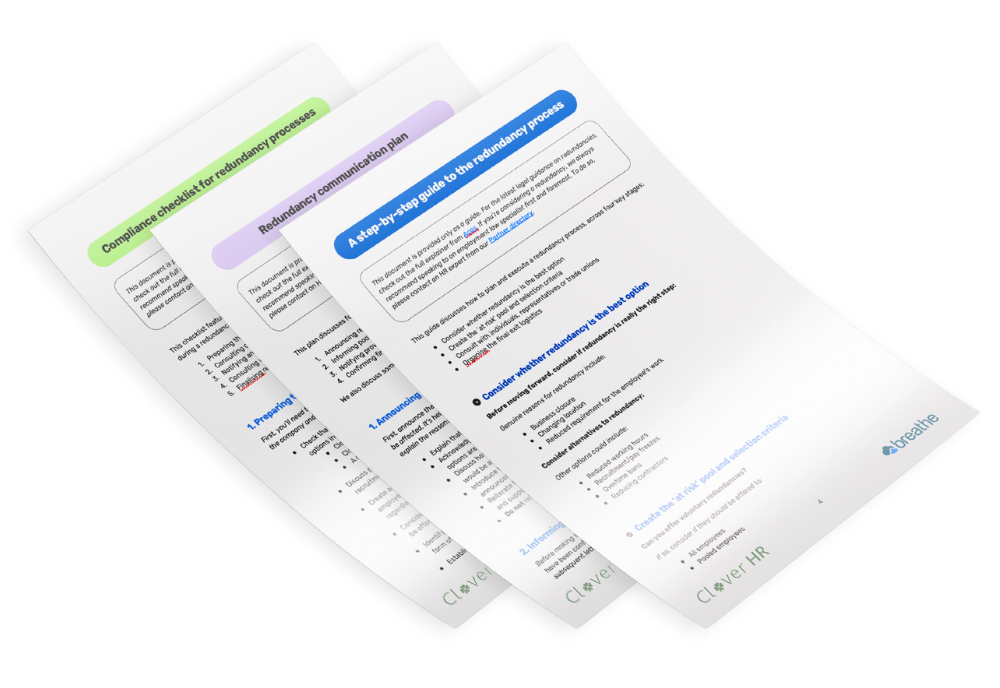
First, you’ll need to ask a series of questions about whether redundancy is the right choice for the company and, if so, how you’re going to go about doing it.
Check that the situation can be considered a genuine legal redundancy. Compliant options include:
Closure of the business
Closure of the branch/office where the employee worked
A reduced requirement for employees to carry out a particular type of work
Discuss potential alternatives to redundancy to avoid unnecessary job losses, e.g. pay freezes, reduced working hours, recruitment/pay freezes, overtime bans or reducing contractors.
Create an ‘at risk’ pool of potential candidates for redundancy. This should include all employees who undertake a similar type of work in a particular department or location, regardless of skill or tenure.
Consider whether voluntary redundancies or alternative positions in the company can be offered to ‘at risk’ candidates.
Identify if any pooled candidates are pregnant, on maternity leave or on some other form of familial leave. Extra rules apply to these situations.
Establish a set of ‘objective criteria’ that can be used to fairly judge candidates and support a fair redundancy process.
Ensure the selection criteria cannot be perceived to unfairly discriminate against any candidate based on characteristics like age, sex, marital status, race, disability, sexual orientation, religion or belief.
Taking a structured approach at this stage sets the foundation for a legally compliant and people-first process.
The rules in this section only apply in cases of collective redundancy - where you’re making more than 20 employees redundant at one establishment within a single 90-day period. Currently ‘one establishment’ is defined as a single office, branch or premises, though the Employment Rights Act will upgrade this to the whole organisation.
Inform the UK Government of your intention to make redundancies by filling out the H1 form on the Government website. This is a legal obligation and must be completed at least 30 days before redundancies take effect, or 45 days if more than 100 employees are being made redundant.
Establish what representation employees will have during collective consultation and, if chosen, in individual redundancy consultation meetings. Choose option A or B:
A) Identify an independent trade union to consult with
B) Hold elections for employee representatives, decided by ‘at risk’ candidates
Officially submit the following information to the relevant trade union/employee representatives before collective consultation begins:
A copy of the HR1 form sent to the Government
Reasons for redundancy proposals
Numbers and type of jobs at risk, including the total selection pool
The scoring criteria, including methods and timescales
The redundancy packages to be agreed
Hold a collective consultation meeting with trade union and/or employee representatives. These discussions should be meaningful and held in good faith, and involve:
Discussing alternatives to redundancy and ways to mitigate the impact
Considering what voluntary redundancy or alternative internal employment options might be available
Confirming the number of candidates to be made redundant and the selection pool from which they’ll be chosen
Agreeing the scoring system
Working collaboratively with representatives shows that your business is taking steps to handle redundancies responsibly and transparently.
Before confirming individual redundancies, you should score all candidates using objective and fair selection criteria. A clear and fair procedure for scoring helps ensure transparency and reduces the risk of legal issues.
Hold a group meeting with all pooled candidates. You should discuss:
The reasons for redundancy
How many redundancies are being made and in which departments
Reinforce that no decisions have been made on individual candidates for redundancy
Additional ways to avoid redundancies, taking suggestions from employees
If voluntary redundancy is an option and, if so, who is eligible
Remind candidates they have the right to take time off to search for additional work
Issue a first letter to all candidates in the selection pool to confirm they are ‘at risk’. This should confirm in writing all information discussed in the meeting and mark the start of the formal consultation period.
Score each candidate, ideally involving input from at least two separate managers. Then, you can identify ‘provisional candidates’ for redundancy based on these scores.

Individual consultation should take place with all candidates provisionally selected for redundancy, regardless of whether the collective redundancy consultation process has already occurred. This should be done before any final decisions are made.
Send a second letter to provisionally selected candidates, formally inviting them to an individual consultation. This should include the reasons they’ve been provisionally selected and the candidates’ full scores - and be issued in ‘sufficient advance’ of the meeting.
Explain that this is just a provisional selection and that no final decisions have been made.
Confirm the employee’s right to have trade union or employee representative support at any redundancy–related meetings.
Remind the employee of their right to appeal the final decision.
Hold an individual consultation meeting with each candidate, discussing:
The scores awarded to each candidate
Any suggestions or criticisms the candidate has of the scores
Details of suitable alternative roles in the company, where appropriate
The redundancy proposal, package and terms
Giving every candidate a chance to comment on their scores helps ensure fairness in the final decision.
When a final decision has been made, it’s time to formally confirm the details.
Send a formal third letter to all candidates confirming the outcome of the consultation and their redundancy.
If the employee chooses to appeal the process, arrange an additional meeting with another manager to discuss their concerns. If necessary, repeat the scoring system and adjust the list of candidates based on this discussion.
Ensure the redundant employees have been provided with suitable notice before the redundancy takes effect, or payment in lieu of notice. The statutory minimum notice period in the UK is dependent on length of service:
One week's notice for employees who have worked with you for one month to two years.
One week's notice per year of service for employees who have worked with you between two and twelve years.
12 week's notice for employees who have worked with you for over 12 years.
Provide redundancy pay in line with the following age requirements. These protections only apply to candidates who’ve worked more than two years*:
Under 22s: Half a week’s pay for each complete year of service
22-41s: One week’s pay for each complete year of service
Over 41s: 1.5 weeks’ pay for each complete year of service
Offer all redundant employees help finding suitable alternative employment.
By finalising the redundancy consultation period thoroughly and transparently, you reduce legal risk and support employee wellbeing.
*This point refers to legal statutory redundancy pay, meaning it follows the legal minimum set by law. Companies may choose to offer an enhanced redundancy package or redundancy payments at their own discretion.
Worried about staying compliant during a redundancy process?
Whether you’re managing a workplace restructure, navigating a redundancy process or facing another HR challenge, Breathehelps you stay compliant, organised and in control. And if you need personal, expert advice, Clover HR (or one of our trusted partners) can guide you through it all.

.webp?width=564&height=513&name=Group%2029%20(1).webp)