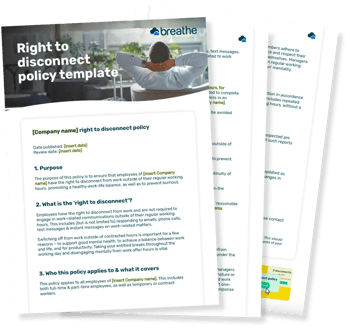
Right to disconnect policy template
Disclaimer: Please note, this template is for informational purposes only. For employment law or HR advice around specific circumstances, please consult a qualified HR or employment law consultant.
[Company name] right to disconnect policy
Date published: [insert date]
Review date: [insert date]
1. purpose
The purpose of this policy is to ensure that employees of [insert Company name] have the right to disconnect from work outside of their regular working hours, promoting a healthy work-life balance, as well as to prevent burnout.
2. What is the 'right to disconnect'?
Employees have the right to disconnect from work and are not required to engage in work-related communications outside of their regular working hours. This includes (but is not limited to) responding to emails, phone calls, text messages & instant messages on work-related matters.
Switching off from work outside of contracted hours is important for a few reasons – to support good mental health, to achieve a balance between work and life, and for productivity. Taking your entitled breaks throughout the working day and disengaging mentally from work after hours is vital.
3. Who this policy applies to & what it covers
This policy applies to all employees of [insert Company name]. This includes both full-time & part-time employees, as well as temporary or contract workers.
This policy covers communication through emails, phone calls, text messages, instant messaging, and any other forms of communication related to work outside of regular working hours.
4. Regular working hours
Regular working hours are defined as [insert specific working hours, for example, 9am to 5pm, Monday to Friday]. Employees are expected to complete their work within these hours and working beyond this time (unless in an emergency, which we’ll cover later) is not expected by [Company name].
Any work-related communication outside of these hours should be avoided unless it falls under the exceptions outlined in this policy below.
5. Exceptions
There are certain exceptions to this policy where communication outside of regular working hours may be necessary. These include:
✓ Emergencies: Situations where immediate action is required to prevent harm or significant loss to the business, employees, or clients.
✓ Business continuity: Critical issues that could impact the continuity of business operations and require immediate attention.
✓ Agreed flexibility: Specific arrangements agreed upon between the employee and their manager for flexible working hours.
Where possible, business communications will be conducted within ‘reasonable hours’ wherever possible [insert timeframe of what the business deems ‘reasonable hours’, e.g. between 8am and 7pm].
6. Responsibilities
Employees:
Employees should respect their colleagues’ right to disconnect and refrain from contacting them outside of regular working hours unless it falls under the exceptions outlined above.
Employees should also communicate their availability clearly to their managers and colleagues. For example, indicating working hours on an email signature or setting an instant messenger status for when an employee has finished work for the day. The email ‘send later’ function can be useful here, or a short onesentence note in your email signature stating that you don’t expect a response outside of the recipient’s working hours.
Managers:
Managers are responsible for ensuring that their team members adhere to this policy. They should promote a healthy work-life balance and respect their team’s right to disconnect, as well as abide by the policy themselves. Managers should also plan work and deadlines to be achievable within regular working hours. Encourage planning ahead, rather than an ‘always-on’ mentality.
7. Non-compliance with this policy
Non-compliance with this policy may result in disciplinary action in accordance with [insert Company name]’s disciplinary procedures. This includes repeated violations of contacting employees outside of regular working hours, without a valid or emergent reason.
8. Reporting issues
Employees who believe their right to disconnect is not being respected are encouraged to report their concerns to their manager or HR. All such reports will be handled confidentially.
9. Review & updates
This policy will be reviewed [e.g. annually – edit as needed] and updated as necessary to ensure its effectiveness and alignment with any changes in legislation or company practices.
10. Effective date
This policy is effective as of [insert date].
For any questions or further clarification regarding this policy, please contact your line manager or the HR team at [insert contact information].

.webp?width=564&height=513&name=Group%2029%20(1).webp)