Free up time for what's important
Holidays are stress-free so why isn't holiday management? Start your free trial today and you'll see how simple holiday management can be with Breathe.

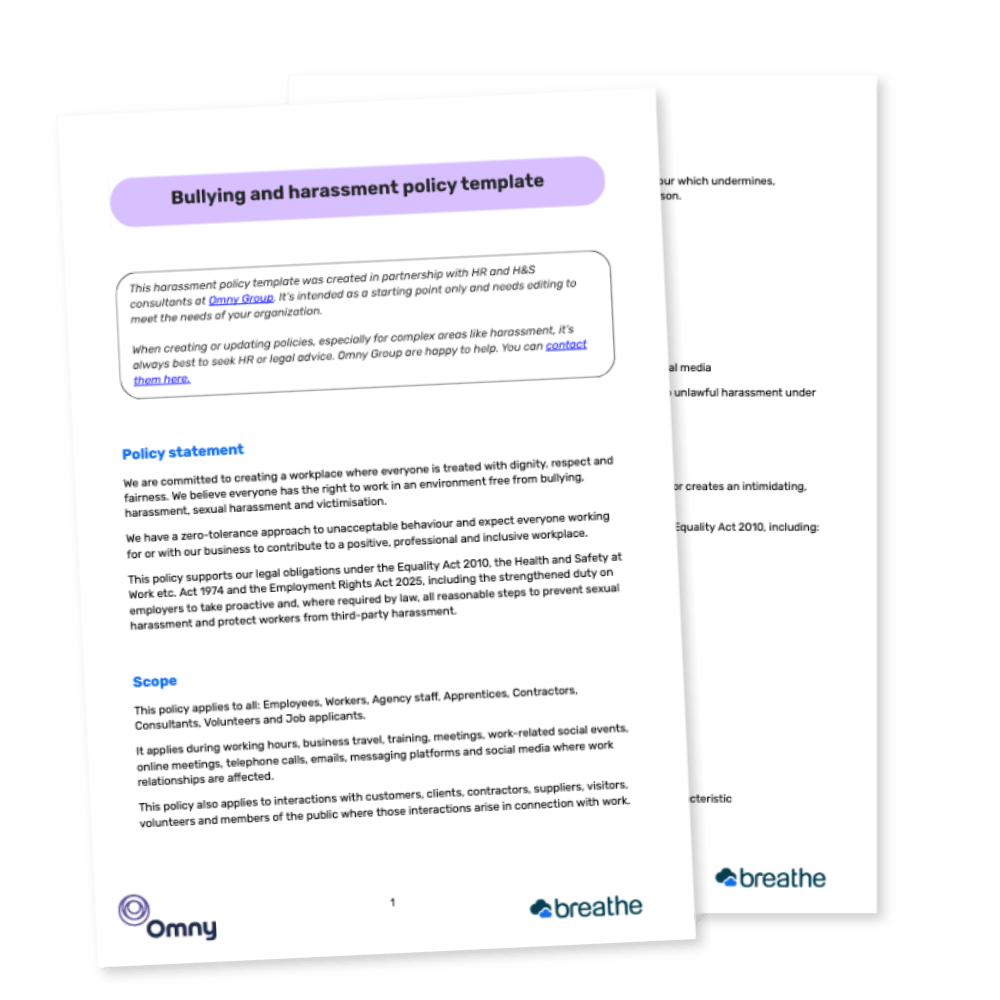

We are committed to creating a workplace where everyone is treated with dignity, respect and fairness. We believe everyone has the right to work in an environment free from bullying, harassment, sexual harassment and victimisation.
We have a zero-tolerance approach to unacceptable behaviour and expect everyone working for or with our business to contribute to a positive, professional and inclusive workplace.
This policy supports our legal obligations under the Equality Act 2010, the Health and Safety at Work etc. Act 1974 and the Employment Rights Act 2025, including the strengthened duty on employers to take proactive and, where required by law, all reasonable steps to prevent sexual harassment and protect workers from third-party harassment.
This policy applies to all: Employees, Workers, Agency staff, Apprentices, Contractors, Consultants, Volunteers and Job applicants.
It applies during working hours, business travel, training, meetings, work-related social events, online meetings, telephone calls, emails, messaging platforms and social media where work relationships are affected.
This policy also applies to interactions with customers, clients, contractors, suppliers, visitors, volunteers and members of the public where those interactions arise in connection with work.
Bullying is offensive, intimidating, malicious or insulting behaviour which undermines, humiliates or causes physical or emotional harm to another person.
Examples include:
Shouting or aggressive behaviour
Persistent criticism or belittling
Intimidation or threatening behaviour
Excluding someone from meetings or work activities
Spreading rumours
Excessive or unreasonable monitoring
Setting unrealistic deadlines
Misusing authority or position
Cyberbullying through email, messaging platforms or social media
Bullying may breach this policy even where it does not amount to unlawful harassment under the Equality Act 2010.
Harassment is unwanted conduct that violates a person's dignity or creates an intimidating, hostile, degrading, humiliating or offensive working environment.
Harassment may relate to any protected characteristic under the Equality Act 2010, including:
Age
Disability
Gender reassignment
Marriage or civil partnership
Pregnancy or maternity
Race
Religion or belief
Sex
Sexual orientation
Examples include:
Offensive jokes or comments
Derogatory language
Mocking someone's accent, disability or beliefs
Displaying offensive images or material
Unwanted physical contact
Deliberately excluding someone because of a protected characteristic
Repeated intrusive questioning
A single serious incident may amount to harassment. Behaviour does not need to be repeated before action is taken.
Sexual harassment is unwanted conduct of a sexual nature that violates a person's dignity or creates an intimidating, hostile, degrading, humiliating or offensive environment.
Examples include:
Sexual comments or jokes
Unwanted touching
Suggestive messages or emails
Requests for dates after being refused
Comments about appearance
Sharing sexually explicit material
Inappropriate gestures or staring
Sexual harassment can occur regardless of gender, sexual orientation, job role or seniority. The intention of the individual is not relevant; the impact on the recipient is what matters.
We are committed to protecting employees from harassment by customers, clients, contractors, suppliers, visitors or any other third party.
Where concerns are raised, we will investigate promptly, assess any ongoing risks and take all reasonable steps to prevent further incidents, including implementing appropriate control measures where necessary.
Managers are expected to:
Lead by example.
Promote a respectful workplace culture.
Complete harassment prevention training
Deal with concerns promptly and fairly.
Escalate concerns even where no formal complaint has been made if there is a risk to employee wellbeing or legal compliance.
Support employees during investigations.
Take proactive and reasonable steps to prevent bullying and harassment.
Everyone is expected to:
Treat others with dignity and respect.
Behave professionally.
Challenge inappropriate behaviour where it is safe to do so.
Report concerns promptly.
Cooperate fully with investigations.
Help create a safe and inclusive working environment.
Employees are encouraged to raise concerns as early as possible.
Where appropriate, issues may be resolved informally by explaining that behaviour is unwelcome.
Where this is not appropriate, or the behaviour continues, concerns should be reported to a manager or HR without delay.
All complaints will be taken seriously, investigated fairly and handled as confidentially as possible.
No employee will suffer retaliation, disadvantage or victimisation for raising a genuine concern or participating in an investigation in good faith.
Reports of sexual harassment may also qualify for protection under whistleblowing legislation where the legal criteria are met.
Where a formal complaint is received, the business will:
Begin an investigation without unreasonable delay.
Speak with all relevant parties.
Review all available evidence.
Maintain confidentiality where possible.
Reach an evidence-based conclusion.
Depending on the outcome, action may include:
Informal resolution
Mediation
Additional training or coaching
Formal disciplinary action
Dismissal where appropriate
All complaints will be handled as confidentially as possible. Information will only be shared with those who need it to investigate or resolve the matter. Absolute confidentiality cannot always be guaranteed where disclosure is necessary to conduct a fair investigation or comply with legal obligations.
Victimisation of anyone who raises a concern, supports another individual or participates in an investigation in good faith will not be tolerated. Victimisation may result in disciplinary action and may constitute unlawful discrimination under the Equality Act 2010.
A complaint that is not upheld will not result in disciplinary action simply because there was insufficient evidence. However, allegations found to have been made knowingly and maliciously may themselves result in disciplinary action.
We are committed to preventing bullying and harassment by:
Providing appropriate training for managers and employees, including regular refresher training.
Carrying out workplace harassment risk assessments where appropriate.
Reviewing workplace culture and behaviours.
Investigating concerns promptly.
Taking appropriate action where unacceptable behaviour is identified.
Regularly assessing workplace risks relating to harassment.
Reviewing the effectiveness of preventative measures following complaints or identified risks.
Monitoring trends and learning from incidents.
Reviewing this policy annually.
This policy forms part of our wider approach to preventing bullying and harassment and should be read alongside our Harassment Risk Assessment, Equality, Diversity and Inclusion Policy, Grievance Policy, Disciplinary Policy and Whistleblowing Policy.
Policy Owner: __________________________
Approved By: __________________________
Effective Date: __________________________
Review Date: __________________________
Version: __________________________
Failure to comply with this policy may result in disciplinary action, up to and including dismissal. The Company reserves the right to review and amend this policy periodically to reflect changes in legislation, guidance and business requirements.
.png)

Holidays are stress-free so why isn't holiday management? Start your free trial today and you'll see how simple holiday management can be with Breathe.