
From 1st January 2027, employees with six months’ service can claim unfair dismissal, and there’s no longer a cap on the compensation a tribunal can award. For most small businesses, that makes the first six months of someone’s job the time to get things right.
It’s the biggest of three changes landing on the same day. Employers also have a new duty to give workers a statement about their right to join a trade union, and tougher rules on tipping start too.
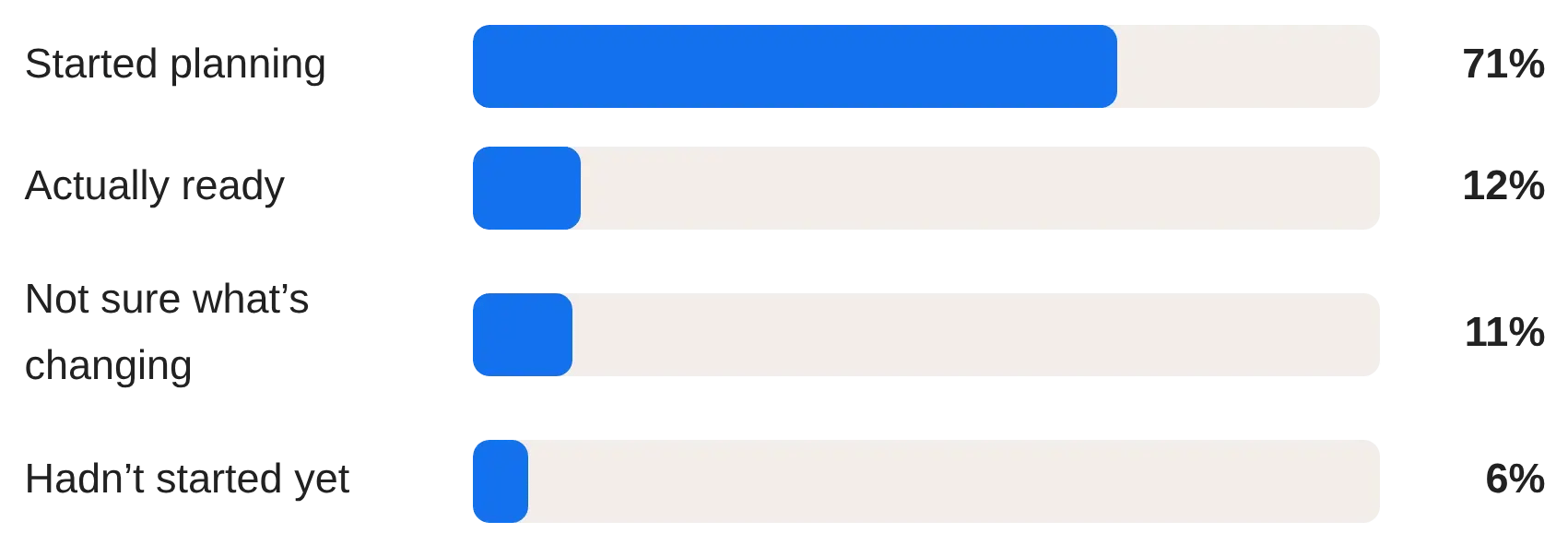
12%
said they were actually ready
When we asked attendees at our webinar with HR Grapevine how ready their business was. While 71% had started planning, only 12% said they were actually ready. A further 11% weren’t sure what was changing and 6% hadn’t started yet.
Luckily, even if you’re not quite ready yet, you still have time left to prepare.
We asked three experts what to do before and after 1st January: Paul Burton, Legal Director and Employment Solicitor at ViewHR, Sarah Ropek, Founder of The Fractional HR Department, and our own, Bharat Siyani, VP People and Culture at Breathe HR. Here’s what they said, with the practical steps to take. You can also watch the webinar on demand.
Paul Burton
Legal Director and Employment Solicitor, ViewHR
Sarah Ropek
Founder, The Fractional HR Department
Bharat Siyani
VP People and Culture, Breathe HR
Skip to section
Unfair dismissal law changes from 1st January 2027: what’s changing and what employers need to do
Tipping law changes: what you need to do before 1st January 2027 if your business handles tips
The January 2027 employment law checklist for small businesses and medium-sized companies
How to put the employment law changes into practice (and prove it)
2 years
Qualifying period today
6 months
From 1st January 2027, with no cap on compensatory awards
From 1st January 2027 in England, Scotland and Wales, the qualifying period for ordinary unfair dismissal drops from two years to six months, and the cap on compensatory awards is removed. Both apply to dismissals from that date. The change comes from the Employment Rights Act 2025, and the unfair dismissal factsheet sets out the detail. Anyone with six months’ service on 1st January could gain unfair dismissal rights, so it’s not only new starters who are affected.
Claims such as discrimination and whistleblowing already apply from day one, and that doesn’t change. What does change is how long you have to decide whether someone is right for the business. Paul put it plainly:
“You’ve got to make a decision whether someone is for you long-term or not, because after six months it will be much more difficult to dismiss them.”
Paul Burton, Legal Director and Employment Solicitor, ViewHR
After six months, Paul explained, you’ll need to run a full procedure and rely on one of the five potentially fair reasons for dismissal, just as you do now for employees with more than two years’ service.
Paul said employers are responding in different ways, from shortening probation to being far more proactive within it. In his view, the most common way forward is:
“A three-month probationary period, with extensions up to, say, five months.”
Paul Burton, Legal Director and Employment Solicitor, ViewHR
If you want that flexibility, he added, make sure the right to extend is written into the contract.
Sarah’s advice is to treat probation differently from now on:
“You really think of probation as your lead-in now to ongoing performance management, ’cause we all know things can go wrong post-probation period.”
Sarah Ropek, Founder, The Fractional HR Department
You can find more in our 2027 unfair dismissal law changes mini webinar and checklist.
From 1st January 2027, employers in England, Scotland and Wales must give new workers a written statement about their right to join a trade union, at the same time as their written statement of employment particulars. Existing workers must also receive it, or be told where to find it in writing, by 5th April 2027. You’ll need to reissue this statement every year onwards by 5th April too.
The government published the standard statement on 17th November, the morning of our webinar. You can find and download the statement here. You must use this exact statement as it is and fill in only the relevant sections, such as which trade unions your business recognises.
Be aware that if a worker later wins another tribunal claim, such as unfair dismissal, and you haven’t given them the statement, a tribunal can award up to four weeks’ pay in extra compensation.
Employers must decide when and how this statement reaches people. Our experts also recommend:
Add the statement to your onboarding pack so nobody who starts in January misses out.
Will you give each worker a printed version? Or will you email it? If you store it on your intranet, shared drive or HR software, you’ll also need to let each worker know in writing where the statement is and how they can access it. Remember though that you’ll need to reissue this statement every year, so think about making the process easy to repeat.
Paul said it’s good practice to ask people to sign and date a copy of their contract and written particulars to confirm they’ve received it, and the statement will form part of that from January. If you use HR software like Breathe HR, you can also request digital acknowledgements from each worker to confirm that they have received and read the statement.
For a full checklist of what to do before 1st January 2027 to meet this duty, use our free trade union law changes checklist, produced in partnership with Jemma Fairclough-Haynes, CEO and Employment Law Specialist at Orchard Employment Law.
Take note: This trade union law change is separate from the trade union access rights that started on 30th October 2026. For more detail on that, see our October 2026 employment law changes blog.
ConsultWhen you draw up or change your written tipping policy
Share a summaryAnonymised summary of the views raised
ReviewAt least every three years, consulting again each time
If your business handles tips, gratuities or service charges, the rules get stricter from 1st January 2027 in England, Scotland and Wales. You’ll need to consult workers when you draw up or change your written tipping policy, give them an anonymised summary of the views raised, and review the policy at least every three years, repeating the consultation each time. The tips and gratuities factsheet explains how it works in more detail.
Bharat suggested starting with the basics that are already law: make sure that tips are going to workers in full, that you have a written policy and you keep records. Then work out who you’ll consult and how you’ll share a summary of what people say. Getting that clear now saves a scramble later.
January is the start, not the finish. The timeline for the Employment Rights Act puts changes for Great Britain in most months of 2027. Paul described how different this is:
“Gone are the days where it used to just be sort of March, April, and then some more in October.”
Paul Burton, Legal Director and Employment Solicitor, ViewHR
Here are the key changes scheduled, in date order.
March 2027
Fire and rehire protections.Dismissing someone because they won’t agree to a change to their contract, such as pay or hours, will become automatically unfair, apart from in very limited circumstances. Paul pointed out that it was originally meant for October, then January, and is now March. When it arrives, he said, changes such as pay and hours will be very hard to make without agreement:
“It’s a very high bar. You will have to show that you’re literally in such financial difficulties that you’re about to go under.”
1st April 2027
Pay rates.The National Living Wage rises to £13.21 an hour and the National Minimum Wage to £11.27.
6th April 2027
Benefits in kind.Benefits in kind must start being reported through payroll in real-time. This includes company cars, car fuel, vans, van fuel and employer-provided medical benefits.
Unconfirmed dates in April 2027
Bereavement leave, including pregnancy loss.A new day one right to up to two weeks of unpaid leave if an employee loses a partner, parent, child or sibling, or an equivalent kinship or foster care relationship. It also covers pregnancy loss before 24 weeks, for the pregnant person and their partner or co-parent.
Collective redundancy.Consultation thresholds will count across the whole organisation, not site by site*.
Blacklisting.Blacklisting protections will extend to AI-drafted lists and to third parties.
Action plans.Menopause action plans and gender pay gap action plans are expected for employers with 250 or more employees.
Summer 2027
Acas Code of Practice.A revised Code of Practice on fire and rehire is expected.
August 2027
Electronic trade union ballots.Electronic balloting for union recognition ballots is expected from August.
September 2027
NDAs voided in some cases.From September, non-disclosure agreements (NDAs) are expected to have no legal effect in harassment and discrimination cases, apart from narrow exceptions.
October 2027
Flexible working requests.Rules change for refusing flexible working requests. You’ll still need one of the existing business reasons to refuse a request, but you’ll need to meet the employee face to face before you decide and explain your decision in writing.
Tip: Bharat’s advice is to look at alternatives before refusing flexible working requests. For example, consider a trial period.
Pregnancy and family leave protection.Dismissal protection is expected to get stronger from day one for pregnant employees and for people on, or recently back from, maternity, paternity, adoption, shared parental, neonatal care or bereaved partner’s paternity leave.
Tip: Bharat suggested updating your family leave policy early.
December 2027
Umbrella company regulations.Tighter regulation of umbrella companies is expected, with more pay transparency for agency workers.
No date yet
Zero hours and guaranteed hours.Employers will have to offer guaranteed hours that reflect the hours someone has actually worked over a reference period, although workers can turn the offer down and stay on a flexible contract. They’ll also need to provide reasonable notice of shifts and compensation for any shifts that are cancelled or reduced at short notice. Our zero-hours contracts guide covers the basics while you wait.
Tip: Bharat’s advice is to start tracking hours properly now for anyone on a zero or low hours contract.
Acas Code of Practice.An updated Acas Code of Practice on disciplinary and grievance procedures. Acas consulted on a fully revised draft until 23rd September 2026, and the final code is expected to take effect in 2027.
Domestic abuse leave.Proposed paid domestic abuse leave is being considered.
Ethnicity and disability pay gap reporting.The government has committed to ethnicity and disability pay gap reporting for employers with 250 or more employees, but hasn’t set a start date.
Non-compete clause reforms.The government is looking at reform of non-compete clauses in employment contracts.
For more detail on all these changes and what to do, watch the full webinar on demand.
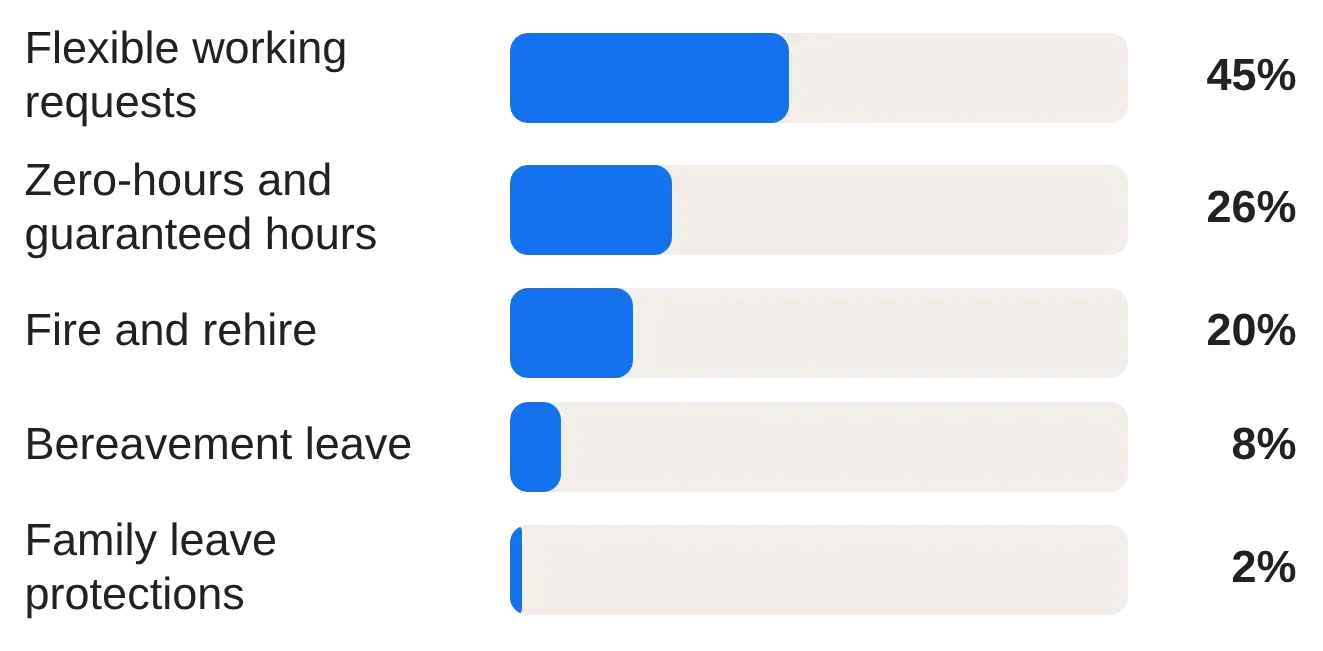
We asked attendees which of these five key 2027 changes worries them most:
Flexible working requests came top with 45%, then zero hours and guaranteed hours with 26% and fire and rehire with 20%.
While fire and rehire came third, our experts felt it deserved more attention than the poll suggests. Sarah said she underestimated it herself when it was first announced:
“I certainly underestimated it when it was announced, because that’s really going to fundamentally change if you want to make changes to how people work in your business, their work patterns and things like that.”
Sarah Ropek, Founder, The Fractional HR Department
From a legal point of view, Paul put it alongside zero hours as one of the two big ones, because of the uncertainty:
“I would’ve said fire and rehire and zero hours were the two big ones [...] We still are uncertain how it’s really going to work.”
Paul Burton, Legal Director and Employment Solicitor, ViewHR
But as outlined above, these changes are just a few of many. And with so many dates, where do you start? Bharat’s answer is to follow the order of the timeline. Because dates can move, starting early means you only need to edit what you’ve done, not redo it. For the latest dates, check out the Breathe HR Employment Law Hub.
*The change in collective redundancy thresholds comes in addition to the change that took force in April 2026 where the maximum protective awards for collective redundancies increased from 90 days to 180 days' pay per employee.
Staying on top of the changes is about building habits, not a one-off push. Bharat reminded attendees that the changes don’t stop on 1st January:
“1st of January isn’t just the finish line, it’s the start of the year of changes, so staying compliant after January is really about building habits.”
Bharat Siyani, VP People and Culture, Breathe HR
His habits are simple:
Put every key date in a shared calendar with a named owner.
Review your policies on a schedule, not just when something goes wrong.
Keep managers briefed at each stage.
Keep an eye on official guidance, because dates have moved before and may move again.
Managers matter most here, because they get the first requests. Sarah’s advice is to give them something practical to work from:
“If we in HR feel like this is a lot, they are certainly gonna be feeling like this is a lot.”
Sarah Ropek, Founder, The Fractional HR Department
A crib sheet or prompt sheet that shows managers how to handle probation reviews, flexible working requests and leave requests will help, especially where a process has changed.
Want your line managers to feel confident handling requests like these? Try Breathe HR’s free employment law essentials training for line managers.
The last habit worth building ahead of January is keeping your records somewhere central. With six-month unfair dismissal claims and no compensation cap, Bharat said:
“Your records are your evidence, so contracts, probation reviews, one-to-one notes, warnings.”
Bharat Siyani, VP People and Culture, Breathe HR
If they’re spread across inboxes, desks and laptops, it’s very hard to show you acted fairly. And as Bharat put it, the businesses that cope best won’t be the ones with the thickest handbook. They’ll be the ones that think about these things routinely.
Most of January’s changes come down to the same thing: showing what you’ve told people, what you’ve asked managers to do and what you’ve put in place. Breathe HR brings all of that together in one system. You can:
Keep employee records and documents, such as contracts, safely stored and easy to find.
Share updated policies with your team and ask for digital acknowledgements.
Assign and keep track of training, including for managers. Breathe Learn includes essential compliance courses, such as harassment, GDPR and discrimination.
Record absence, including bereavement leave, and keep track of flexible working requests alongside it.
Use Breathe Rota, Time & Attendance to record the hours people actually work, which helps you stay on top of zero hours and irregular hours workers.
This blog contains general guidance to help you plan. If you’re weighing up a specific dismissal or contract change, speak to an employment solicitor or an HR consultant before you act. Sarah, Paul or any of our other Breathe HR partners would be happy to help.
Sarah says: Treat the end of a fixed-term contract as a dismissal that needs a fair reason and a fair process. Not renewing a contract has always counted as a dismissal, but from 1st January 2027 anyone with six months’ service can challenge it, and compensation is no longer capped. Review each contract’s end date now. The unfair dismissal factsheet has more information.
Paul says: Handle ending a fixed-term contract like any other dismissal. Check whether the contract allows early termination, have a fair reason such as redundancy or capability, follow a fair process and keep a written record. From 1st January 2027, employees with six months’ service can claim unfair dismissal, so skipping steps carries more risk. A contract that simply runs out and isn’t renewed still needs a fair reason to bring it to an end.
Sarah says: You don’t need to shorten a three-month probation period, and doing so won’t remove the risk. You can include a contract clause allowing you to extend probation where needed, but remember that notice can count towards an employee’s service when working out whether they have reached six months. Hold your review meetings on time and leave enough time to follow a fair process and account for notice.
Sarah says: Yes, you still need to share the trade union rights statement. The duty applies to every employer, whether or not you recognise a union. The standard statement has sections for recognised unions and statutory access agreements. You should complete these or confirm there are none.
Paul says: Use the government’s standardised trade union rights statement. You must give workers the standardised statement and you can’t add to it or change it, apart from filling in the workplace details the regulations require or allow, such as the unions you recognise.
Sarah says: Yes, there are set times for giving the trade union rights statement. From 1st January 2027, new workers must get the statement at the same time as their written statement of employment particulars. Existing workers, meaning anyone employed before 1st January 2027, must get it by 5th April 2027. The guidance for employers sets out the dates.
Paul says: No, the government guidance we’ve seen doesn’t require employees to sign and date that they’ve received the trade union rights statement. But asking people to sign and date a copy is good practice, because it gives you proof that they received it. Keep the signed copy with their employee record. With Breathe HR, you can ask each worker to digitally acknowledge the statement and keep a clear record of who’s received it.
Paul says: For new workers, a shared drive isn’t enough. You must give them the trade union rights statement directly alongside their written statement of employment particulars. For existing workers, you can either give it to them or tell them in writing where to find it by 5th April 2027, so a shared drive can work if you point people to it in writing.
Paul says: The trade union right of access is about reaching your workers, so it doesn’t give a union a general right to your client data. Data protection law still applies, which means you need a lawful basis before sharing anyone’s personal data. Check any request against your client contracts and your data protection obligations.
Paul says: Agree the practical arrangements for clearance levels with the union as part of the access agreement. Arrangements can include reasonable conditions or safeguards, and access must be refused where it’s necessary in the interests of national security. Access shouldn’t unreasonably interfere with your business.
Paul says: It depends on the arrangement, and since October 2026 more of them are covered. Since 1st October 2026, right to work checks cover a wider range of working arrangements, including individual sub-contractors and workers engaged under a worker’s contract. Where an agency supplies staff, the agency is their employer and is responsible for checking them. Read the employer’s guide and make sure to get any arrangements in writing.
Paul says: No, guaranteed hours won’t automatically make casual workers employees. The new right is to be offered guaranteed hours, not a change in employment status.
Paul says: Probably, yes, you’ll need to pay workers if a client cancels, moves or cuts short a shift at short notice. The meaning of short notice, the amount and any exceptions will be set in regulations, so check the final rules when they’re published. You may want to account for the potential payment in your commercial agreements with clients so they, in effect, are liable to cover the payment.
Sarah says: Employers will need to offer guaranteed hours. Workers won’t have to ask, unlike with flexible working. Qualifying workers get an offer of guaranteed hours that reflects the hours they’ve worked over a reference period, and they can turn it down and stay on their current arrangement.
Bharat says: Under the guaranteed hours changes, the offer is based on the hours someone worked over a reference period, which will be set in regulations. A student who only works in the holidays won’t have a regular pattern for most of the year, and workers can turn the offer down. Start recording hours worked now, so you can show what pattern someone has really worked.
Paul says: Workers on zero hours and low hours contracts will have the right to be offered guaranteed hours, reasonable notice of shifts and changes, and payment if a shift is cancelled, moved or cut short at short notice. The detail, including who qualifies, will be set out in regulations.
Sarah says: The government hasn’t yet confirmed what counts as very short notice for cancelled shifts but it will be set in regulations. The consultation on the detail asked for views on how to define it and whether to have a separate very short notice category. Keep an eye on the Breathe HR Employment Law Hub for the final rules.
Paul says: The rules on temporary layoffs themselves haven’t changed and the changes to fire and rehire and zero-hours law don’t prevent you from making temporary layoffs.
Bharat says: You can only reject a flexible working request where it’s reasonable to do so, and you must explain why by referring to one or more of the eight existing business reasons, such as extra costs or a harmful effect on meeting customer demand. A new consultation process before rejecting a request will be set out in secondary legislation.
Bharat says: We’re awaiting further guidance on evidence, but we know you will have to explain your reasons for rejecting a flexible working request in writing and in a face-to-face meeting. So, for any requests you refuse, make sure to write down why the request won’t work and which alternatives you considered. Before rejecting, always consider other options such as a trial period.
Paul says: An approved statutory flexible working request is a permanent change to the employee’s terms and conditions, so that means you need to update their contract and confirm the new terms in writing. You can instead agree a temporary change or trial period, if you both agree. Put the end or review date in writing, so everyone knows what happens when it finishes.
Paul says: Statutory bereavement leave arrives in April 2027, for employees who lose a partner, parent, child or sibling, or an equivalent kinship or foster care relationship, and after pregnancy loss before 24 weeks. Stronger flexible working rules follow later in the year and dismissal protection for pregnant employees and people on or returning from family leave is also expected to get stronger in October 2027. Zero hours changes may also help parents and carers who need predictable shifts.
Sarah says: Employees will qualify for statutory bereavement leave from their first day. This covers immediate family, including partners, parents, children and siblings, and equivalent kinship and foster care relationships. It also covers pregnancy loss before 24 weeks, for the pregnant person and their partner or co-parent.
Bharat says: You don’t need two separate documents for bereavement leave and bereaved partner’s paternity leave, but treat them as two rights. Bereaved partner’s paternity leave is a separate entitlement, and statutory bereavement leave covers different situations with its own rules. Set each out clearly in your policies so managers know which one applies.
Sarah says: No, day one statutory paternity and maternity leave doesn’t automatically include pay. Leave is a day one right but pay still depends on the usual rules. Paternity pay keeps its 26-week qualifying period, and statutory maternity pay has its own service and earnings tests. So someone can take the leave from day one without being eligible for statutory pay.
Bharat says: No, don’t ask a new starter about plans to take paternity or maternity leave. Questions about family plans risk a discrimination claim, and discrimination claims never needed a qualifying period. Judge probation on performance against the same criteria you use for everyone and record your reasons. Taking or planning family leave should never be a reason to extend or end a probation period.
Paul says: You only need to consult on your existing tipping policy if you’re changing it. From 1st January 2027, you must consult workers when you draw up or change your written tipping policy, and again each time you review it, at least every three years. If your policy isn’t changing before 1st January, just put the review in your diary.
Paul says: Yes, the January 2027 changes apply to businesses with fewer than 20 employees. The unfair dismissal, trade union rights statement and tipping changes apply to employers of every size.
Paul says: The changes apply to whoever employs the staff after the deal. In a business sale, TUPE usually transfers employees to the new employer on their existing terms, with their service counting as continuous. In a share sale, the employer doesn’t change at all. Either way, new rights such as the six-month unfair dismissal qualifying period apply from 1st January 2027.
Paul says: No, you are not legally required to publish a gender pay gap action plan for the report filed in April 2026, but will be required to publish an action plan for April 2027 alongside your report, and continue to do this every year.
Sarah says: Keep employee paperwork for as long as the person works for you and for any further period needed for a legal or genuine business reason. Holiday and holiday pay records must be kept for six years from the date each record was made. Under data protection law, you should only keep what you still need and review your retention periods regularly.
Yes, you can use Rota, Time & Attendance for just part of your team. Rota, Time & Attendance is an add-on to Breathe HR, with plans priced by team size. You can start with Rota only, Time & Attendance only, or both together, so you only use what you need. Employees are brought across from Core HR, but you assign the relevant workers to the appropriate location and job. Rotas are then built around those assignments, so employees outside that operational group don’t need to appear on the rota.
Breathe HR is brilliantly simple HR software for UK small and medium-sized businesses with up to 250 employees. It brings more of the HR side of your business together in one connected platform. It’s modular, so you can start with core HR, which covers holiday and absence tracking, employee records and documents, and people reporting, then add more as your business grows. You can try it free for 14 days.