Office DSE assessment template
In partnership with Omny Group
In partnership with Omny Group
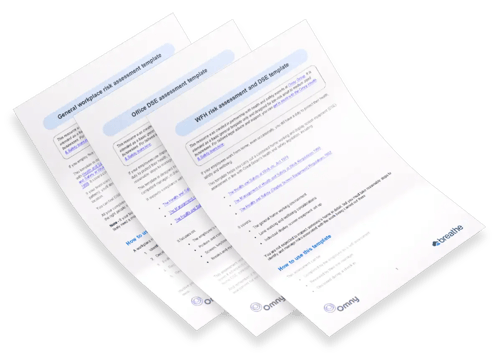
This resource was created in partnership with health and safety experts at Omny Group. It is intended as a basic general template only and designed for low-risk small to medium sized businesses. For tailored legal advice and support, you can get in touch with the Omny Health & Safety team here.
If your employees use display screen equipment (DSE) as part of their role in the office, you have a duty to protect their health, safety and wellbeing. This includes assessing their set-up and taking reasonable steps to manage any risks linked to DSE use.
This template is designed to be completed by the responsible health and safety person, or a competent manager, in discussion with an individual employee.
It supports compliance with:
The Management of Health and Safety at Work Regulations 1999
The Health and Safety (Display Screen Equipment) Regulations 1992
It focuses on:
The employee’s workstation set-up
Posture and comfort
Screen, keyboard and mouse positioning
Breaks and eyesight
This assessment relates to office-based working. If the employee also works from home sometimes (even if infrequently), you should also ask them to complete a home working risk assessment and home DSE assessment. There’s a free template for this here.
And remember, if the employee works in multiple office locations, you’ll need to complete a DSE assessment for each one.
If employees hot desk, assess a typical workstation set-up and make sure all desks, chairs and screens can be easily adjusted to suit the user, with clear guidance provided on how to set them up correctly.
Review the workstation in person
Talk through each section with the employee
Observe how the employee works at their desk
Record findings and any actions required
Where issues are identified, practical steps should be agreed and recorded in the action plan.
| Employee name: | |
| Job title: | |
| Department: | |
| Work location: | |
| Assessor name: | |
| Assessor role: | |
|
Date of assessment |
|
|
Next review date: |
Complete the following sections, based on observation and discussion with the employee.
| Chair and posture | Yes/No |
| Chair height is adjustable and set correctly | |
| Backrest is adjustable and provides appropriate lower back support | |
| Employee can sit with feet flat on the floor or on a footrest | |
| Elbows are level with, or slightly above, the desk when typing | |
| Employee understands how to adjust their chair | |
| No signs or reports of work-related aches, pains, numbness or tingling |
| Screen set up | Yes/No |
| Screen is directly in front of the employee | |
| Top of the screen is roughly at eye level | |
| Screen is at a comfortable viewing distance | |
| Screen is free from glare or strong reflections | |
| Brightness and contrast can be adjusted | |
| Image is clear and stable | |
| If using a separate screen, it can twist and swivel | |
| If using multiple screens, they are positioned to avoid twisting |
| Keyboard and mouse | Yes/No |
| Keyboard and mouse are positioned so arms are relaxed | |
| There is space to rest wrists and forearms | |
| Desk space is sufficient for equipment and documents | |
| Employee uses a separate keyboard and mouse |
| Other equipment and working practices | Yes/No |
| Headset provided where regular phone use is required | |
| Document holder provided where needed | |
| Employee varies tasks where possible | |
| Employee takes regular short breaks from screen work | |
| Employee changes posture and moves around during the day |
| Eyes and eyesight | Yes/No |
| Employee changes posture and moves around during the day | |
| Employee is aware of entitlement to eye tests for DSE use | |
| No reported eye strain, headaches or screen-related discomfort |
Ask the employee if they have a disability or medical condition and feel that they need adjustments to help them work safely and comfortably? Record their response in the box below.
Do either you or the employee feel they need more training on setting up their workstation safely? If yes, record what training is required in the box below.
In the table below, record any risks identified in the tables above, as well as:
Any agreed actions to control those risks
The person responsible for those actions
The deadline by which those actions must be taken
You can add more rows if needed.
Remember to also include any actions or reasonable adjustments that are required to support the employee if they have a disability or medical condition.
When an action has been completed, come back here and record the date on which the action was taken.
| Risk | Action required | Responsible person | Deadline (Date) | Completed on (Date) |
I confirm that I have participated in this assessment and discussed my workstation and working practices.
Where risks have been identified, appropriate actions and deadlines have been agreed and recorded.
Employee name:
Signature:
Date:
I confirm that I have carried out this assessment carefully and considered the employee’s health and safety.
Where risks have been identified, appropriate actions and deadlines have been agreed and recorded.
Assessor name:
Signature:
Date:
This assessment should be kept under review and revisited if any working arrangements change or if the employee reports discomfort of concerns.
Now you’ve completed your DSE assessment, make sure it’s stored somewhere safe, secure and easy to access – for both you and the employee.
With Breathe, you can upload completed DSE assessments to the employee’s record, keeping them alongside everything else, from contracts to sick leave and booked holiday. So, all the important details about your people live in one place.
You can also manage wider health and safety responsibilities in the same system – creating risk assessments, recording incidents, assigning roles like first aiders and fire wardens, and keeping track of certifications.
It all connects, so you can see the full picture and feel confident nothing’s slipping through the cracks.

.webp?width=564&height=513&name=Group%2029%20(1).webp)