HR templates
HR templates
Managing priorities effectively can be challenging, especially for SMEs where multitasking is the norm. Poor prioritisation can lead to missed deadlines, decreased productivity, and team frustration.
Our team prioritisation ‘how to’ template offers a structured and practical approach to help SMEs streamline task management, improve team focus, and align efforts with business goals.
Effective prioritisation is essential for operational success and employee satisfaction. For SMEs, having a clear approach to managing priorities helps to:
Minimise operational disruptions: Ensure tasks align with business goals and avoid chaos
Improve communication and transparency: Clearly communicate priorities to keep everyone on the same page
Enhance productivity: Focus efforts on high-impact tasks for better results
Support employee wellbeing: Prevent burnout by managing workloads and expectations effectively
Adapt to changes smoothly: Quickly realign priorities as business needs evolve
Our template provides a comprehensive framework for managing priorities effectively:
Implementing effective prioritisation doesn’t need to be an overload. Our ‘how to’ template is designed to help your business manage tasks and help your people work on projects efficiently.
With Breathe’s performance management software, you can easily manage and track priorities, keeping your team aligned and focused.
Disclaimer: Please note, this template is for informational purposes only. For employment law or HR advice around specific circumstances, please consult a qualified HR or employment law consultant.
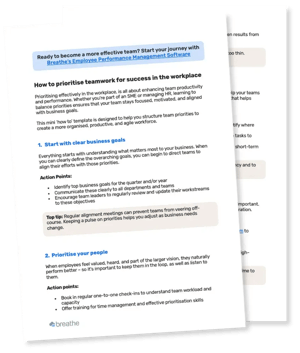
Prioritising effectively in the workplace, is all about enhancing team productivity and performance. Whether you're part of an SME or managing HR, learning to balance priorities ensures that your team stays focused, motivated, and aligned with business goals.
This mini ‘how to’ guide is designed to help you structure team priorities to create a more organised, productive, and agile workforce.
Everything starts with understanding what matters most to your business. When you can clearly define the overarching goals, you can begin to direct teams to align their efforts with those priorities.
Action Points:
Identify top business goals for the quarter and/or year
Communicate these clearly to all departments and teams
Encourage team leaders to regularly review and update their workstreams to these objectives
Top tip: Regular alignment meetings can prevent teams from veering offcourse. Keeping a pulse on priorities helps you adjust as business needs change.
When employees feel valued, heard, and part of the larger vision, they naturally perform better – so it’s important to keep them in the loop, as well as listen to them.
Action points:
Book in regular one-to-one check-ins to understand team workload and capacity
Offer training for time management and effective prioritisation skills
Emphasise work-life balance to prevent burnout (which often results from taking on too many tasks without clear priorities)
Remember: People can't do their best work if they're stretched too thin. Prioritising wellbeing should always be high on the agenda.
Once goals are clear, a structure for managing tasks is essential. Help your teams decide what's important by creating a decision-making framework that helps them easily evaluate the importance of their tasks.
Action points:
Introduce the Eisenhower Matrix (urgent vs important) to identify where team efforts should go
Use OKRs (objectives and key results) to link individual or team tasks to larger company goals
Establish a regular cadence of weekly planning sessions to set short-term priorities
Top tip: Encourage teams to batch similar tasks together for efficiency and to prevent task-switching fatigue.
Technology plays a vital role in staying organised and on top of what's important. Equip your teams with the right tools for task management and collaboration.
Action points:
Introduce project management software like Trello, or Monday.com to centralise task lists
Encourage team leaders to use calendar blocking or timeboxing techniques
Automate repetitive tasks whenever possible to free up time for highpriority work, with software like Breathe
Automation isn't about replacing people - it's about giving them back time to focus on work that matters.
Team prioritisation is a skill that can always be improved. Encourage a culture where learning how to work smarter, not harder, is celebrated. Create opportunities for your teams to develop new skills that help them prioritise better.
Action points:
Offer training sessions on productivity tools, workflow automation, and project management
Foster a growth mindset where team members feel comfortable discussing workload challenges and adjusting priorities openly
Use real-life examples of successful prioritisation to inspire teams
Prioritisation is a skill that evolves - continue to encourage reflection and growth.
No plan is perfect. Flexibility is key when managing shifting priorities in a dynamic workplace. Teams need to learn to regularly review their task lists and adapt to changing circumstances.
Action points:
Build flexibility into the team’s workflow by allowing for regular review and adjustment of priorities
Implement weekly, monthly and/or quarterly retrospectives where teams can reflect on what worked well and what could be improved
Create an environment where it’s okay to say ‘no’ or delegate tasks that don’t align with current priorities.
Top tip: Ask your teams at the end of every week: What should we stop doing? What should we start doing? What needs to be continued?
Subscribe to the Breathe blog