Health and safety for small businesses checklist
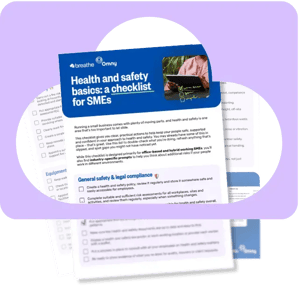
Running a small business comes with plenty of moving parts, and health and safety is one area that’s too important to let slide.
This health and safety for small businesses checklist gives you clear, practical actions to help keep your people safe, supported and confident in your approach to health and safety. You may already have some of this in place – that’s great.
Use this list to double-check what you’re doing, refresh anything that’s slipped, and spot gaps you might not have noticed yet.
While this checklist is designed primarily for office-based and hybrid working SMEs, you’ll also find industry-specific prompts to help you think about additional risks if your people work in different environments.
Health and safety for SMEs checklist
General safety & legal compliance 🛡️
☐ Create a health and safety policy, review it regularly and store it somewhere safe and easily accessible for employees. You can also review other essential documentation such as your wider HR policies for SMEs to make sure everything aligns.
☐ Complete suitable and sufficient risk assessments for all workplaces, sites and activities, and review them regularly, especially when something changes.
☐ Name one clear owner or “competent person” responsible for health and safety overall, and make sure there’s clear day-to-day responsibility at each site or location.
☐ Put appropriate first aid arrangements in place based on your risks, size and working patterns.
☐ Make sure key health and safety documents are up to date and easy to find.
☐ Display a health and safety law poster at each working location or provide each worker with a leaflet.
☐ Put a process in place to consult with all your employees on health and safety matters.
☐ Be ready to show evidence of what you’ve done for audits, insurers or client requests.
Fire safety 🔥
☐ Carry out a fire risk assessment for each site and location and keep it under review, looking at hazards, who might be at risk, escape routes, and how a fire would be detected and alarm raised.
☐ Put appropriate fire detection and alarm systems in place based on your risk assessment(s).
☐ Provide suitable fire-fighting equipment where needed and arrange professional servicing where appropriate.
☐ Clearly mark fire exits and keep escape routes clear, well-lit and easy to use.
☐ Create a simple fire evacuation plan for each site and practice it twice per year.
☐ Keep records of fire risk assessments, checks, servicing and drills in one accessible place.
☐ Appoint a sufficient number of fire wardens to carry out evacuation procedures and support fire safety arrangements.
Equipment & workplace safety 🖥️
☐ Keep walkways, work areas and exits clear and safe to use.
☐ Check that work equipment is safe, well maintained and suitable for the job at each site or location. This includes desks, tools, machinery or vehicles.
☐ Appoint a sufficient number of first aiders and provide suitable first aid supplies and facilities for your workplace needs.
☐ Complete DSE (display screen equipment) assessments for anyone who regularly works on a screen, including office, home and hybrid workers.
☐ Review DSE assessments when roles, locations or equipment change.
☐ Provide practical guidance or training where manual handling is part of the role.
☐ Put a clear process in place for reporting faulty equipment, hazards or near misses.
☐ Carry out electrical safety checks and PAT testing where needed, based on risk and how equipment is used.
☐ Keep maintenance records, risk assessments and inspection logs for all sites in one central place.
Wellbeing & mental health 🧠
☐ Include stress and mental health risks in your health and safety risk assessments.
☐ Name a clear point of contact for wellbeing concerns, such as a manager or HR.
☐ Encourage regular breaks and manageable workloads, especially during busy or high-pressure periods.
☐ Maintain safe, clean and comfortable working environments across all sites and working locations.
☐ Respond to concerns raised and make reasonable adjustments where you can.
☐ Keep a simple record of agreed actions or adjustments, so follow-ups don’t get missed.
Training & awareness 🎓
☐ Provide clear health and safety training when people start, tailored to the risks in their role and relevant to the sites and environments they work in.
☐ Explain how to recognise and log risks, near misses, incidents and accidents, and why reporting matters. Educate everyone on which accidents and incidents need to be reported to the Health and Safety Executive (HSE).
☐ Provide refresher training on a regular basis and when things change, such as new equipment, locations or ways of working.
☐ Make policies, procedures and guidance easy to find, read and understand.
☐ Record health and safety training completed by each individual, including dates and confirmation they’ve completed and understood it.
☐ Store training records, policies, risk assessments and incident logs for all sites in one central place.
🏢 Industry-specific considerations
The checklist above covers the basics for office-based and hybrid SMEs. Depending on how and where your people work, you may also need to consider additional risks.
☐ Construction: Working at height, site safety, contractor management, competence records.
☐ Education: Safeguarding, infection control, supervision, incident reporting.
☐ Field service and trade: Lone working, driving safety, working at height, off-site incident reporting.
☐ Healthcare and care: Infection control, manual handling of people, hazardous waste, food hygiene where relevant.
☐ Manufacturing and assembly: Machinery safety, manual handling, noise or vibration, maintenance records.
☐ Not for profit: Safeguarding, lone working, emotional wellbeing, volunteer safety.
☐ Retail and hospitality: Slips and spills, fire safety in public areas, manual handling, food hygiene where relevant.
Your risk assessments should reflect how your organisation actually operates, not just what’s written in a policy.
NOTE: This checklist has been created in partnership with health and safety experts at Omny Group – an HR and employment law consultancy and one of our trusted Breathe Partners. It is intended as a helpful guide, not a replacement for legal advice or professional health and safety support. Every business is different, so it’s important to make sure your approach reflects how and where your people actually work, and to seek competent advice where needed.
Need legal advice or health and safety support? Get in touch with Omny Group today.
Final tip
Keeping your team safe is an ongoing effort, and you don’t have to do it alone. Using simple software to store and track your health and safety tasks, records and reminders can take the pressure off and give you peace of mind.
Step-by-step for small businesses making their own checklist
At Breathe, we know that your people are your biggest asset. Looking after their wellbeing is all about creating a space where everyone feels supported and safe.
If you’re looking for a health and safety for small businesses checklist, here’s how to get the basics right while keeping things human.
1. Start with your team
The best way to build great health and safety practices is to talk to the people doing the work. Chat with your team about their day-to-day and listen to their ideas on how to make things safer. It keeps everyone informed and shows you genuinely care about their success.
2. Create a helpful health and safety policy
If you have five or more employees, health and safety law says you need a written policy. Don't worry, this doesn't have to be a mountain of paperwork.
A good health and safety policy simply outlines how you’ll keep people safe and who’s responsible for what. It’s your team’s guidebook for a happy workplace.
A quick note: If you have fewer than five people, you don't legally have to write your policy down, but it’s still a great way to show your team you’ve got their back.
3. Focus on a comfortable environment
A great culture starts with a workplace that feels good to be in. As part of your health and safety management, check that your team has what they need to stay focused, like plenty of light and a reasonable working temperature.
Usually, this means at least 16°C, or 13°C if your team is doing physical work.
4. Spot and manage risks
Take a wander around and look for anything that could cause a bit of a headache. You don’t need to worry about every tiny thing; just focus on the real risks that are likely to happen.
Once you’ve spotted them, decide on some simple, practical steps to keep everyone protected.
5. Name your "competent person"
You don't have to be an expert in everything. Find a person with the right skills to help you lead on health and safety management.
This could be a member of your team who's keen to step up, or a friendly external advisor you can call on for support.
6. Make safety visible
It’s a requirement of health and safety law to display the official ‘Health and Safety Law’ poster. It might seem small, but having it clearly visible reminds your team of their rights and shows you’re committed to a safe, transparent culture.
7. Be prepared for accidents
We hope they never happen, but it’s best to be ready. Make sure your first aid kit is well-stocked and easy to reach.
If a more serious incident occurs, ensure it’s recorded and reported correctly. This helps you learn and improve your health and safety practices for the future.
8. Get the right insurance
Most businesses with employees are legally required to have Employers’ Liability insurance. It’s a key part of your health and safety practices as it protects both you and your team if someone gets ill or injured at work.
Remember to display your insurance certificate where the team can see it.
9. Keep things growing
As your business evolves, your approach to safety should too. Regularly checking in on your processes is important for compliance and making sure your workplace stays a great place to be as you grow.
Frequently asked questions
-
What should a health and safety policy include in the UK?
Your health and safety policy should outline your approach to keeping people safe. It needs to cover responsibilities, how you identify hazards, and what you’re doing to reduce risks. If you have five or more employees, this must be in writing to comply with UK law.
-
How often should I carry out a risk assessment?
You should review risk assessments regularly - especially when something changes, like equipment, people or locations. They help you spot potential safety issues before they cause harm and are a key part of staying compliant.
-
Who’s responsible for first aid in the workplace?
Employers are legally required to provide appropriate first aid cover based on the risks, size and setup of their workplace. This includes having the right first aid kits, trained people in place, and clear processes so everyone knows what to do if there’s an emergency.
These responsibilities are set out in The Health and Safety (First-Aid) Regulations 1981, which require employers to assess their needs and make sure suitable first aid arrangements are in place.
-
How is workplace health and safety evolving in 2026?
Workplace health and safety practices in 2026 are becoming more data-driven. More businesses are starting to integrate physical safety data with mental wellbeing data. Health and safety systems help employers collect and utilise data from accidents and audits to continuously improve safety procedures.
The definition of health and safety is also expanding to include cyber-physical safety with employers now recognising the safety risks that are associated with cybersecurity and human-machine interaction in workplaces.
-
What is the Health and Safety at Work Act 1974?
The Health and Safety at Work Act 1974 is the main piece of legislation covering workplace health and safety in the UK. It mandates a safe working environment and proper equipment maintenance. This includes your legal duty to protect the health, safety and welfare of your employees - as well as anyone affected by your work, including customers, contractors and the public.
It also mandates things like offering the right training, managing risks, planning for emergencies and ensuring that welfare facilities like clean toilets and drinking water are available. Workers are also required to be involved in safety decisions.
UK law also requires that certain work related accidents must be reported under the Reporting of Injuries, Diseases and Dangerous Occurrences Regulations 2013 (RIDDOR).
-
What are the key principles of effective health and safety?
The primary goal of health and safety is to prevent injuries, illness and even death – and that means being proactive, not reactive. Prevention starts with strong risk assessments, clear responsibilities, and practical training that reflects the reality of your workplace.
An effective safety system is built on four essentials: commitment from leaders, competence across the team, clear communication, and consistent control of risks. Everyone has a role to play, and safety should be a shared responsibility between employers and employees.
Fundamentally, health and safety is all about preventing harm before it happens and making sure everyone knows the basics – like evacuation routes, fire alarm locations, assembly points and first aid procedures.
-
What are employer responsibilities around manual handling?
Under the Manual Handling Operations Regulations 1992, employers must avoid risky lifting where they can. If manual handling is needed, provide guidance and training to reduce the risk of injuries.
-
How do I build a positive safety culture at work?
A great safety culture comes from the top. That means leadership buy-in, open communication, and making sure everyone understands their role. Regular reviews and honest conversations help create trust and keep people safe.
-
Why is it important to keep health and safety documents up to date?
Up-to-date records show you’re serious about safety and help you track progress over time. They’re also vital for audits, insurance and proving you’re meeting your legal duties.
-
How should employers psychosocial risks like work-related stress and burnout?
Employers have a legal duty to protect their team from work-related stress and other psychosocial risks - like burnout, bullying or harassment. That means identifying potential causes, taking them seriously, and putting steps in place to prevent harm.
This could include reviewing workloads, encouraging regular breaks, creating safe spaces to raise concerns, and offering support when people need it. These risks should also be part of your health and safety risk assessment – they’re just as important as physical hazards.
Join over 17,000 SMEs that choose Breathe as their #1 HR software provider

.webp?width=564&height=513&name=Group%2029%20(1).webp)